Your European Airline Miles Were Invisible. Now They're Not.
Last updated: June 4, 2026. Loyalty programs change rules frequently. Verify with the program before relying on this for a redemption.
If you collect points, you already know the quiet problem: your balances live in a dozen different places. A few hundred miles here, fifty thousand there, scattered across logins you only remember when you actually need them. And the worst part is the stuff that disappears while you weren’t looking. Miles expire on schedules nobody memorizes, and by the time you notice, they’re already gone.
That problem is bad enough if you fly US airlines. It’s worse if you fly in Europe, because most points trackers were built around the US programs first and treated everything else as an afterthought. If your miles sat with Air France, KLM, Lufthansa, British Airways, or Virgin Atlantic, you were largely on your own, checking each one by hand or not at all.
That changes with this update. PointsPulse now tracks 17 loyalty programs, and this update added five major international airlines. If you fly in Europe, your miles are now visible in the same dashboard as everything else, pulled in automatically, with no passwords stored anywhere. This post walks through each of the new programs, how their miles actually behave, and the expiration quirk worth knowing for each one.
Why European miles get neglected
There’s a structural reason European frequent flyer balances tend to fall through the cracks for points-tracking tools. The hobby’s center of gravity, at least online, is heavily US-focused: the big trackers, the big forums, the big blogs all grew up around Chase, Amex, and the US airlines. International programs got added later, unevenly, and often only the ones that doubled as US transfer partners.
But a huge number of people hold meaningful balances in these programs. Anyone based in Europe, obviously, but also US-based hobbyists who transferred points into Flying Blue or Avios for a specific redemption, then forgot about the leftover balance. Those mid-sized international airline balances are some of the most commonly lost, because they sit in an account you don’t log into often and they expire on a clock you’re not watching.
Surfacing the balance automatically is the entire fix. You can’t lose track of a number that’s sitting in front of you. So here’s what’s now covered, and what to watch for with each.
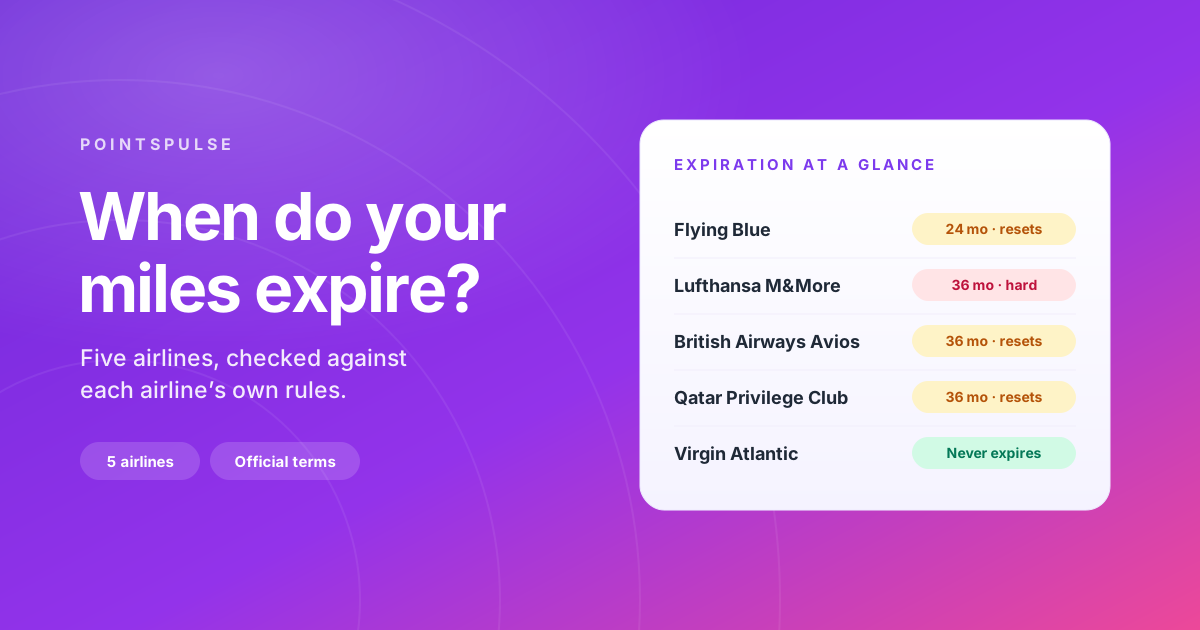
| Program | Alliance / currency | Do the miles expire? |
|---|---|---|
| Flying Blue (Air France / KLM) | SkyTeam | Only after 24 months of no activity. Any earning (a flight, a partner purchase, even a points transfer) resets the clock on your whole balance. Elite members, Flying Blue Extra subscribers, under-18s, and Germany-based members don’t have to worry. |
| Lufthansa Miles & More | Star Alliance | Yes, 36 months after each mile is earned. This is a hard deadline: activity does not extend it. The only way out is holding elite status or a Miles & More credit card. |
| British Airways Avios | oneworld / Avios | Only after 36 months of no activity. Any earning or spending resets the clock, so regular use keeps them alive indefinitely. |
| Qatar Privilege Club | oneworld / Avios | Only after 36 months of no activity. Same Avios rule as BA: any earning or redemption resets the clock. |
| Virgin Atlantic Flying Club | Virgin / SkyTeam partners | Never. Virgin removed expiry in September 2020, so there’s nothing to track. |
Flying Blue (Air France / KLM)
Flying Blue is the SkyTeam anchor for much of Europe, and the home program for a lot of Amsterdam and Paris based flyers. It’s strong for earning through everyday flying, its shopping portal, and a deep list of transfer partners (in the US it’s a transfer partner of Amex, Chase, Citi, Capital One, and Bilt), which means a lot of people end up holding a balance even if they rarely fly Air France or KLM.
The expiration rule is the thing to know, and it changed recently. As of an update that went live May 4, 2026, any earning activity now resets the expiration date on your entire balance, and miles run on a 24-month-from-activity clock. Under the old rules, only certain activity types reset the clock, and even then only on subsets of your miles, which was needlessly confusing. The new rule is simpler: one balance, one expiration date, any earning resets it.
Several groups are exempt from expiration entirely: Flying Blue Silver, Gold, Platinum, and Ultimate elite members; Flying Blue Extra subscribers; co-branded credit card holders; and members who are minors. One regional wrinkle worth noting since it’s relevant to a big chunk of the audience: members based in Germany retain the previous three-year validity. Flying Blue was also the trickiest of the five to build a reliable reader for, so if you hold a balance here, it’s satisfying to have it tracked cleanly.
Lufthansa Miles & More
Miles & More is the largest frequent flyer program in the German-speaking world and the anchor for anyone flying Lufthansa, Swiss, Austrian, Brussels Airlines, or their partners. If you fly in central Europe with any regularity, this is very likely your primary balance.
The expiration rules here are genuinely complicated, which is exactly why having the balance surfaced matters more for this program than almost any other. Each batch of miles is valid for 36 months from the date you earn it, and then expires at the end of that quarter. The important and often-missed detail: this is a hard expiration. Unlike the Avios programs, ordinary activity does not extend your miles, earning or spending more won’t buy your older miles additional time. The clock on a given batch of miles runs out 36 months after you earned that batch, full stop.
There are only two ways to escape the 36-month clock: hold Miles & More elite status (Frequent Traveller, Senator, or HON Circle), or hold a Miles & More credit card and meet its conditions. With status, your miles are protected as long as you keep it; lose the status and the 36-month expiry applies again. Because the rule is a fixed deadline rather than an inactivity timer, it catches people out more than the reset-on-activity programs do.
One honest note on how we handle this in the dashboard: because the Miles & More expiration logic is so conditional, PointsPulse shows an expiration date for this program only when the program itself displays a concrete date, rather than us calculating one that might be wrong. Your balance tracks reliably; the expiry field stays empty until there’s a real date to show. We would rather show you nothing than show you a date we can’t stand behind. The balance, which is the part you check most often, is always there.
British Airways Avios
Avios are one of the most useful currencies in the entire hobby, and not because of British Airways alone. The same Avios balance works across British Airways, Iberia, Aer Lingus, Qatar Airways, and the wider Avios network, and you can move Avios between those programs. That interchangeability is what makes the balance more valuable than a single airline’s miles usually are.
On expiration: Avios technically lapse after 36 months of inactivity, but any earning or redemption resets that clock. Because most US transfer partners move Avios in regularly (Amex, Chase, Citi, Capital One, and Bilt all transfer to Avios), keeping an account active is rarely a real concern for anyone using it even occasionally. British Airways trimmed the value of its program in recent years, but the flexibility of Avios as a currency is what keeps it worth holding. Now you can see the balance without digging through the BA site each time.
Qatar Airways Privilege Club
Qatar isn’t a European airline, so it’s the odd one out on this list, but it earns its place here: it’s a favorite of European travelers, who lean on its strong network out of Europe and its premium-cabin product for long-haul trips. Privilege Club is a favorite for premium-cabin redemptions and a strong oneworld option, particularly if you fly long-haul or book expensive, last-minute tickets where the earning rate genuinely shines. Privilege Club also uses Avios as its currency and ties into the wider Avios ecosystem, so the balance is more flexible than it first appears, you’re not locked into Qatar-only redemptions.
For most members the practical expiration story matches British Airways: Avios lapse after 36 months of inactivity, but any earning or redemption resets the clock, so regular earners rarely brush up against it. As with the others, the value of tracking here is simply seeing the number alongside everything else, so a balance you built up for one big redemption doesn’t quietly slip your mind.
Virgin Atlantic Flying Club
Virgin Atlantic Flying Club is the simplest of the five in the way that matters most: Virgin Points do not expire. Virgin removed the old 36-month inactivity expiry when it rebranded the currency to Virgin Points in September 2020, so there’s no clock ticking down on your balance at all. In a hobby full of deadlines, that’s a genuinely nice thing to be able to stop worrying about. (You’ll still see some older guides repeating the pre-2020 inactivity rule, but Virgin’s own terms confirm Points no longer expire.)
Flying Club is also a clever transfer and redemption partner, with a broad set of partners feeding into it (Delta, ANA, Air France, KLM, and the major transferable bank currencies) and some standout redemption sweet spots. Because there’s no expiration, the dashboard simply shows your balance with nothing to count down, which is exactly how it should be. Track it, then forget about the expiry entirely.
Why a balance you can actually see matters
It sounds obvious, but the entire value of tracking is that the number is in front of you before you need it. Almost every points horror story is the same story: someone had a balance, didn’t look at it for a while, and a chunk of it expired. Or they forgot an account existed entirely until long after the miles were gone.
The most dangerous balances, statistically, are mid-sized international airline miles sitting in your transfer-partner list, the Flying Blue or Avios balance you topped up for one specific trip that didn’t happen, then stopped thinking about. Twelve to thirty-six months later, gone. Virgin Points are the exception here, they don’t expire, so you can leave that balance alone safely. Lufthansa is the strictest, a hard 36-month deadline that activity won’t extend unless you have status, while the Avios programs just need occasional activity. Either way, the ones with a clock need a set of eyes on them, and that’s precisely the job a tracker does better than memory.
A single dashboard that pulls all of this together changes the default. Instead of remembering to check fifteen separate sites, you see everything in one place, and the programs with expiration clocks show you where you stand. PointsPulse also emails you ahead of known expiration dates, so the deadline finds you rather than the other way around.
How this works without your passwords
Here’s the part that matters if you’ve ever been uneasy about handing a third party your loyalty logins. You should be uneasy about that, and we built PointsPulse specifically so you never have to.
PointsPulse never asks for your loyalty program passwords, and it never stores them. It can’t, because it doesn’t work that way. When you’re already logged into a program in your own browser, the extension reads your balance from the page you’re looking at, locally, on your own machine. That number syncs to your dashboard. Your credentials never leave your browser and never touch our servers, because we never see them in the first place.
That’s the whole design philosophy. Plenty of tools ask you to store your usernames and passwords with them so they can log in on your behalf. That’s convenient right up until it isn’t, and it’s the exact thing that has burned points collectors before, whether through a breach or just the discomfort of a third party holding the keys to a dozen accounts. We built the opposite: a tracker that reads, never logs in, and never holds anything it shouldn’t. The five new airlines work the same way as every other program in the dashboard, your balance, read locally, nothing stored.
Getting set up
If you’ve got miles sitting with any of these programs, this update is the reason to set up your dashboard now. Add the programs you use, and the next time you log into each one in your browser, your balance appears in a single view, no passwords, no manual checking, no expiration surprises.
One small heads-up if you already use PointsPulse: because adding these airlines required new site permissions, Chrome may show the extension as disabled after it updates and ask you to re-approve permissions. That’s expected with an update like this, not a problem. Just click accept (you’ll see the prompt via the extensions puzzle-piece icon in your toolbar, or at the extensions page) and you’ll be on the latest version with all fifteen programs.
For everyone flying in Europe whose balances have been scattered and unwatched, that’s the point of this release: the miles you couldn’t easily see are now all in one place, and the ones with a clock on them finally have something keeping track.
Track your points without giving up your passwords
PointsPulse is a privacy-first Chrome extension. Start for free, no credit card required.
Try PointsPulse free