The Best Points and Miles Trackers in 2026
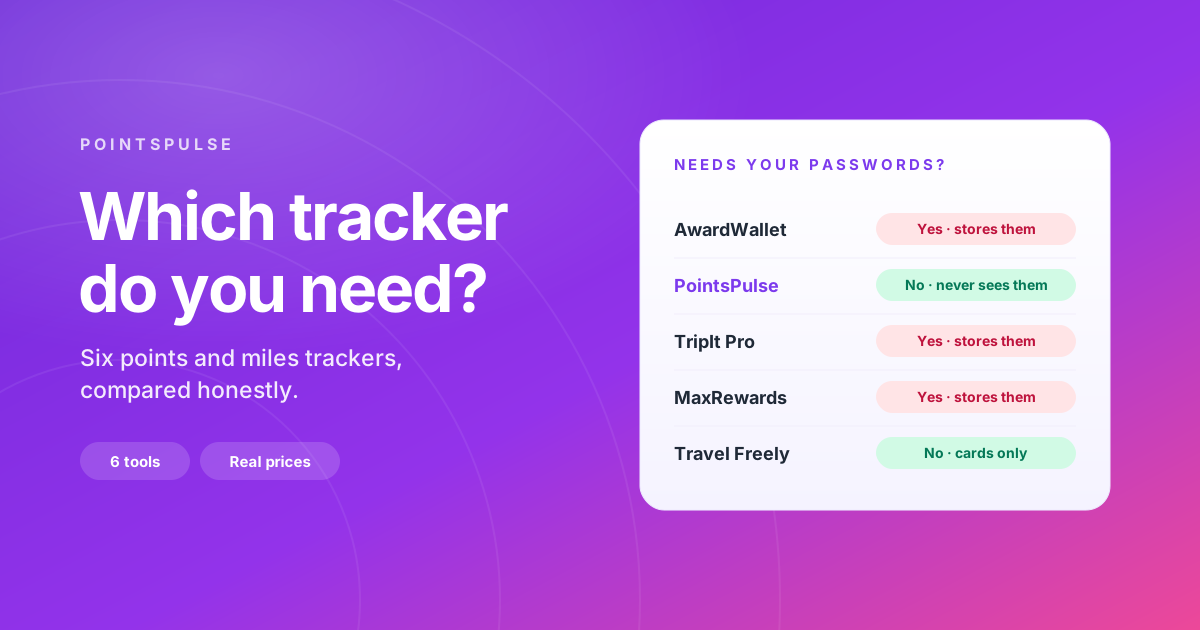
We built PointsPulse, which is one of the tools reviewed below. We have tried to be honest about where it loses. Where a competitor is the better fit, we say so.
Most people arrive at a points tracker the same way. You have a Marriott balance, a Chase balance, two airline programs you barely think about, and a nagging sense that something somewhere is quietly about to expire. You are not trying to become a points hobbyist. You are trying to stop losing money you already earned.
That is the whole job of a points tracker: put every balance in one place, and tell you before anything disappears. What follows is an honest look at the tools that do it, and, more usefully, which kind of collector each one actually suits. They are not competing for the same person as often as the marketing suggests.
One note on language before we start. People search for a points tracker and a miles tracker as if they were different products, and the tools themselves often lean one way or the other. In practice you almost always want both in one place, because a Marriott balance and a United balance expire on their own separate clocks and forgetting either one costs you the same. Every tool below is judged on whether it covers the whole picture.
What a points tracker actually needs to do
Before the list, it is worth naming the four jobs, because most tools are good at some and bad at others.
- Aggregate balances. Show every program in one view instead of ten browser tabs.
- Keep balances current. A number that was right three months ago is a liability, not information.
- Warn before expiration. This is the one that has actual monetary value. A hundred thousand Marriott points quietly expiring is a $700 loss.
- Do it without creating a new risk. A tracker that holds the keys to fifteen of your accounts has to be worth the exposure.
Almost every disagreement about trackers is really a disagreement about the last two.
AwardWallet
Free tier available. AwardWallet Plus is $49.99 a year.
The category leader, in market since 2004, and still the most complete product by a wide margin. It tracks more than 600 programs, including hundreds of niche ones no competitor touches. If you hold Diners Club, Hawaiian, or a hotel program nobody has heard of, AwardWallet has you covered and nothing else does.
What it does well. Breadth, maturity, and mobile. It has real iOS and Android apps, family account management so you can watch a spouse's or child's balances, and it tracks free night certificates, which expire on a hard date and are easy to forget. Two decades of surviving program redesigns is a genuine moat.
Where it falls short. The most common question people ask about it is simply is AwardWallet safe, and the fair answer is that it has a good security record and a risky model. It requires your loyalty program passwords, because AwardWallet logs into your accounts on your behalf. There was a 2015 incident affecting roughly 250 accounts with weak or reused passwords, which AwardWallet disclosed, and no mass breach in two decades. That is a real track record. But the exposure is structural rather than hypothetical, and we have written about why we think credential storage is the wrong trade in more detail. That is the founding design decision and everything else follows from it. It also means the big US carriers have been steadily shutting the door: American AAdvantage was removed entirely in 2023, and Delta, United, and Southwest now require you to forward statement emails rather than update automatically. Two factor authentication has made the rest increasingly unreliable. And the price moved from $30 to $49.99 in December 2024, which landed badly with subscribers who had been grandfathered at $10.
Choose it if you have a long, sprawling list of programs including international and obscure ones, you want a phone app, and you are comfortable handing over passwords. If you already use it and are looking to leave, we have a separate post on the best AwardWallet alternatives.
PointsPulse
Free tier for up to 3 programs. PointsPulse Pro is $5.99 a month, $39.99 a year, or $99 once for lifetime access.
Our tool, so weigh this accordingly. It is a Chrome extension that reads your balance off the loyalty site when you are already logged in and looking at it. It never asks for a password, never stores one, and never logs in on your behalf, because it does not need to. The tracking rides on things you were going to do anyway. You log into Chase to pay the card bill, into United to book a flight, into Marriott to check a reservation, and the balance is already on the screen in front of you. PointsPulse reads it and files it away. There is no separate step, no syncing to remember, and nothing to maintain. It supports 15 major programs: Marriott, Hilton, Hyatt, Chase Ultimate Rewards, Amex Membership Rewards, Citi ThankYou, American, United, Delta, Southwest, British Airways Avios, Qatar Privilege Club, Flying Blue, Virgin Atlantic, and Lufthansa Miles and More.
What it does well. It tracks all four major US airlines directly, with no email forwarding, because it is reading the page you are already on rather than trying to log in. Two factor authentication is a non-issue for the same reason: you complete it yourself, as you normally would, and the extension reads the balance afterwards. Expiration alerts on Pro fire at 60, 30, 14, 7, and 1 day out, though the free tier only gets the 7 day warning. And the security exposure is structurally different. There is no password database to breach, because there are no passwords.
Where it falls short. Fifteen programs is not six hundred. If your list is long or unusual, we will not cover it. It is Chrome only, with no mobile app, so you cannot check balances from your phone. It only updates when you actually visit the loyalty site, so a program you never log into will go stale.
Choose it if your programs are mostly the major US ones, you care about the four big airlines updating automatically, or you are simply not willing to give a third party your Chase and Amex logins.
TripIt Pro
$49 a year.
Not really a points tracker. It is an itinerary manager with points tracking bolted on, and the itinerary half is genuinely excellent. Forward a confirmation email and TripIt builds your trip automatically. Real time flight alerts frequently beat the airline's own notifications. Its Point Tracker covers 130 plus programs as a secondary feature.
Where it falls short. The tracking is not the product and it shows. If you want a tracker, you are paying $49 a year for a travel app that also tracks.
Choose it if you fly constantly and the itinerary management alone justifies the price. Treat the point tracking as a bonus.
MaxRewards
$108 a year for Gold.
A credit card tool, not a loyalty tracker. It automatically activates Amex Offers and Chase Freedom quarterly categories, which is real, measurable value if you run a lot of cards and keep forgetting to click the offers.
Where it falls short. It does not track hotel or airline loyalty balances at all. It is solving a different problem.
Choose it if you are card heavy and offer activation is where you leak value. Use it alongside a tracker, not instead of one.
Travel Freely
Free.
Tracks credit card applications, sign up bonus deadlines, annual fee dates, and Chase 5/24 status. Notably, it asks for no card numbers and no bank logins, just the names and dates of the cards you have opened. Philosophically close to our own approach, applied to a different problem.
Where it falls short. No balances. It tracks the cards, not the points in the programs.
Choose it if you are churning. It is free and it is the best free thing in this list. Pair it with a balance tracker.
The spreadsheet
Free.
Genuinely worth taking seriously. Plenty of serious hobbyists run a Google Sheet with a row per program, a last activity date, and a calculated expiration date, and it beats every commercial tracker on control and cost.
Where it falls short. Every balance is a manual copy and paste from a loyalty site, so it degrades exactly when you get busy, which is the same moment you are most likely to lose track of something. A stale spreadsheet is more dangerous than no spreadsheet, because it feels like a system.
Choose it if you have three or four programs and the discipline to update it. If you have twelve, you will not.
Side by side
| Tool | Price | Programs | Needs your passwords | Expiration alerts | Mobile |
|---|---|---|---|---|---|
| AwardWallet | Free, or $49.99/yr | 600+ | Yes | Yes | iOS and Android |
| PointsPulse | Free (3), $39.99/yr, $99 lifetime | 15 | No | 7 day (free), 60/30/14/7/1 day (Pro) | No |
| TripIt Pro | $49/yr | 130+ | Yes | Limited | iOS and Android |
| MaxRewards | $108/yr | Cards only | Yes | No balances tracked | iOS and Android |
| Travel Freely | Free | Cards only | No | Bonus deadlines only | Web and app |
| Spreadsheet | Free | Any | No | Only if you build them | Anywhere |
The two questions that actually decide it
Strip away the feature lists and the choice comes down to two things.
First: how long is your list, really? Be honest rather than aspirational. If you hold six major US programs, breadth is not your problem and paying for 600 program coverage buys you nothing. If you hold twenty, including a European airline and two hotel chains nobody has heard of, breadth is the only thing that matters and AwardWallet is your answer.
Second: are you willing to hand over passwords? There is no neutral answer here, only a trade. Password storage is what buys AwardWallet its breadth, because logging in as you is the only way to reach 600 programs. It is also what exposes you, and what the airlines have been progressively shutting down. Reading the page you are already looking at avoids the exposure entirely, but it can only see the sites you actually visit, and it takes real engineering per program, which is why our list is 15 and not 600.
Neither model is free. Pick the cost you would rather pay.
The thing nobody tells you
Whichever tool you pick, the value is not in the dashboard. It is in the alert.
Nobody has ever recovered meaningful money by admiring a tidy list of balances. People recover money when something tells them that 94,000 Hilton points go away in three weeks, in time to do the one small thing that resets the clock. If you are not sure which of your programs are even on a clock, start with our program by program breakdown of expiration rules. That is the entire return on investment of this category, and it is why an expiration alert you actually receive is worth more than a hundred programs you never look at.
So the wrong tracker, used, beats the right tracker, abandoned. Whether you end up calling it a points tracker or a miles tracker matters far less than whether you will still have it running in six months. Pick the one you will actually keep.
Track every balance without handing over a single password
PointsPulse reads your balances from the loyalty sites you already log into, and warns you before anything expires. Free for up to 3 programs, no credit card required.
Try PointsPulse free