The Points and Miles Audit: How to Find the Balances You Forgot You Had
Last updated: May 27, 2026. Loyalty program rules and redemption rates change often. Verify current details with each program before acting.
Ask most people to audit their points and they will open a spreadsheet and start adding up balances. That feels productive, but it is the wrong instinct. The total at the bottom of the page is the least useful number in the whole exercise.
An audit is not about counting what you have. It is about catching what you are quietly losing. Points do not just sit there safely waiting for you. They leak value in four specific ways, and a real audit is the process of finding each leak before it costs you a trip.
The four ways points leak value
Before the step by step, it helps to know what you are actually looking for. Every balance you own falls into one of these buckets, and the at-risk ones are the entire point of the audit.
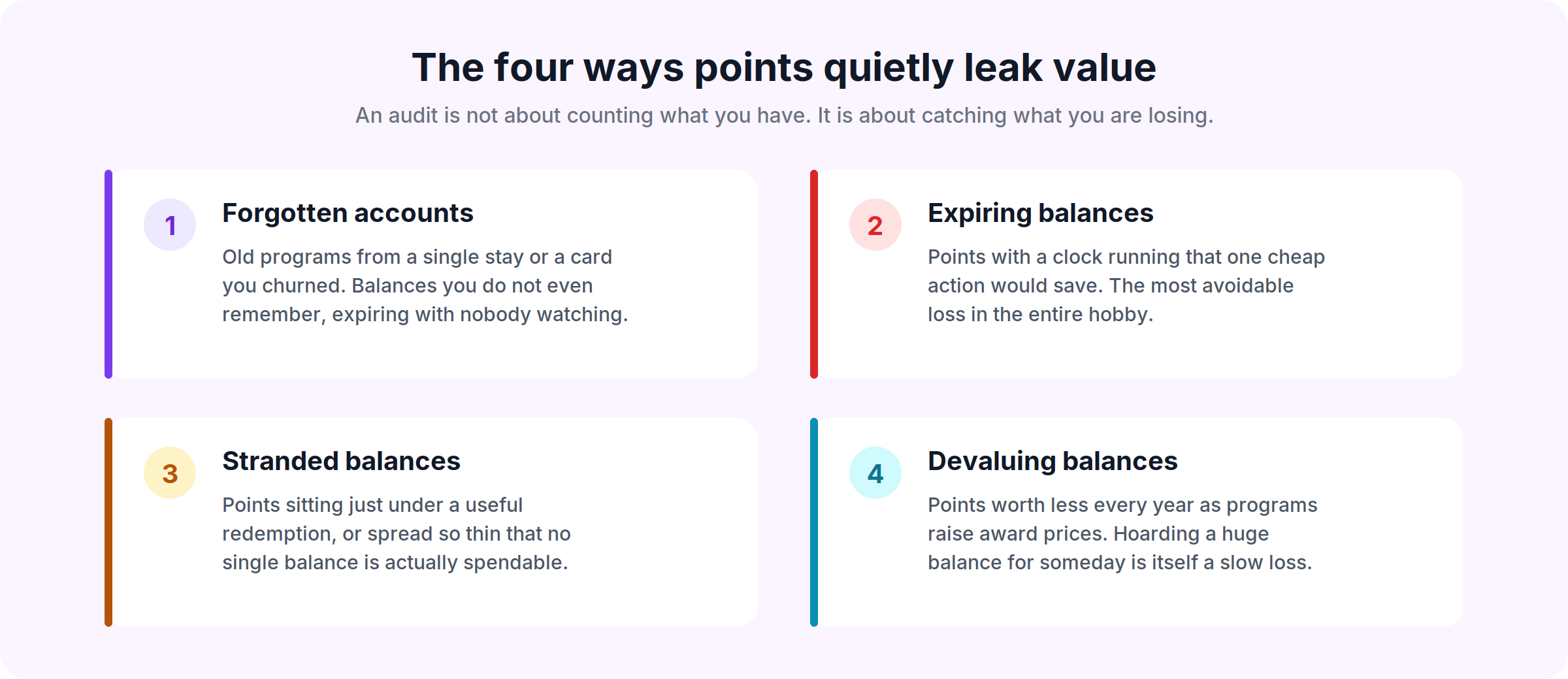
Notice that only one of these (expiring balances) is about a deadline. The other three are slower and quieter, which is exactly why they go unnoticed for years. Let us walk through finding each one.
Leak one: the accounts you forgot you have
This is the most common and the most painful, because you cannot protect a balance you do not remember exists. Forgotten accounts come from predictable places: a single hotel stay years ago that earned you a few thousand points, a credit card you opened for a bonus and later closed, an airline you flew once on a work trip, a dining or shopping program you signed up for and never used again.
How to surface them. Search your email inbox for terms like “welcome,” “your account,” “points balance,” and “statement,” plus the names of programs you have any memory of touching. Check your password manager for saved loyalty logins. Think back through every hotel chain you have stayed with and every airline you have flown, not just the ones you use now. The goal is a complete list, including the accounts you would never think of on your own.
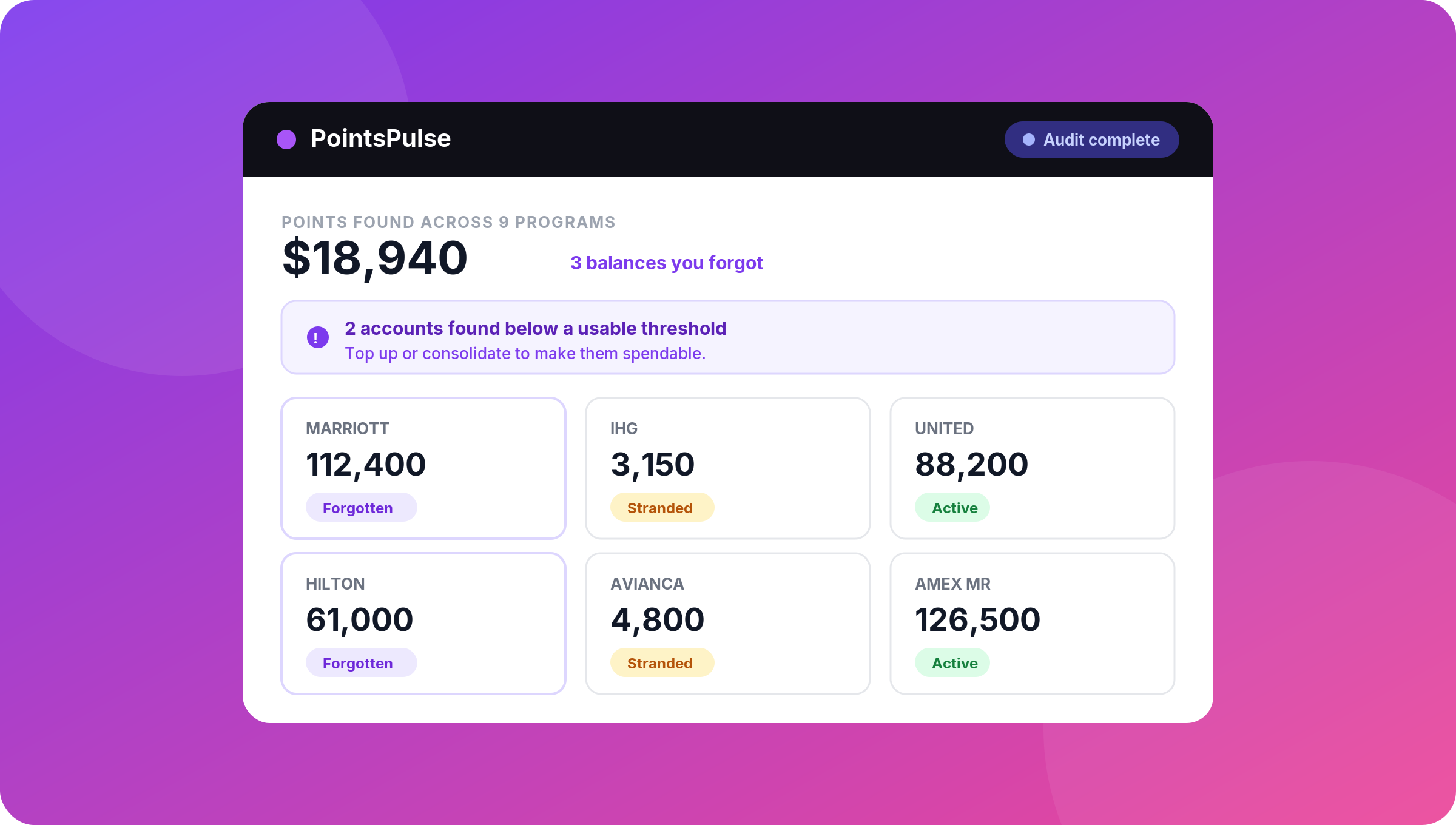
Write every one down, even the tiny balances. A forgotten 8,000 point Hilton balance is still worth real money, and more importantly, forgotten accounts are the ones most likely to silently expire because nobody is watching them.
Leak two: the balances with a clock running
Once you have a full list, the next pass is expiration. Many programs forfeit your points after a period of inactivity, and the windows are shorter than people expect. IHG is just 12 months. Several others run 18 to 24 months. Most programs do not warn you, and simply logging in does not reset the clock.
For each account on your list, find the last activity date and the program’s inactivity window, then flag anything that will lapse in the next several months. The fix is almost always cheap, often free, and a single small action resets the clock on the entire balance. We covered the cheapest qualifying activity for every major program in detail here: How to Save Expiring Points Without Spending Real Money. For the underlying rules, see Do Loyalty Points Really Expire?
The audit job here is simply to know which clocks are running. The saving is the easy part once you know.
Leak three: the balances you cannot actually spend
This one is subtle and almost nobody checks for it. You can have points that are not expiring and not forgotten, but still effectively useless, because they are stranded.
Stranded balances come in two shapes. The first is a balance sitting just below a useful redemption: 3,150 IHG points when the cheap nights you want start around 10,000, or 4,800 miles when the award you would book needs 7,500. The second is value spread so thin across many programs that no single balance is big enough to do anything, even though the combined total looks healthy.
The fix is consolidation or a small top up. Many balances can be nudged over a useful threshold by transferring in from a flexible currency you already hold, or by pooling within a family account where the program allows it. The audit move is to flag every balance that is close to, but not quite at, something you would actually redeem, and decide whether topping it up unlocks real value or whether you should just spend it down and close the account.
One honest caution: do not transfer flexible points into a program speculatively just to round up a balance. Flexible currencies are usually worth more kept flexible. Only top up when you have a specific redemption in mind.
Leak four: the balances quietly losing value while you hold them
The last leak is the one that feels least urgent and does the most cumulative damage. Points are a depreciating currency. Programs raise award prices over time, sometimes sharply and without notice, which means the giant balance you are proudly hoarding for “someday” buys less every year you hold it.
There is no transaction that fixes this one. The fix is a mindset shift you apply during the audit: treat large balances as something to use, not to accumulate indefinitely. If you are sitting on a balance far larger than anything you have concrete plans to redeem, that is not a safety cushion. It is exposure to the next devaluation. Earn points closer to when you intend to use them, and redeem meaningful balances while you know what they are worth.
The audit, step by step
Putting it together, here is the actual process. Set aside an hour once a year.
- List every program. Including the forgotten ones you surfaced from your email and password manager. Leave nothing off.
- Record balance and last activity date for each. The last activity date is what tells you how much runway you have before expiration.
- Tag each balance against the four leaks: forgotten, expiring soon, stranded, or oversized and devaluing.
- Act on the urgent ones first. Anything expiring in the next few months gets a cheap resetting activity now. Anything stranded gets a decision: top up or spend down.
- Set one reminder for the next audit, and a few specific reminders for accounts with the shortest expiration clocks.
A simple table is all you need to run it:
| Program | Balance | Last activity | Status | Action |
|---|---|---|---|---|
| Marriott Bonvoy | 112,400 | 14 mo ago | Forgotten | Reset clock, then plan a redemption |
| IHG One Rewards | 3,150 | 3 mo ago | Stranded | Top up or spend down and close |
| United MileagePlus | 88,200 | 1 mo ago | Active | None needed |
| Amex Membership Rewards | 126,500 | This month | Oversized | Plan a redemption this year |
Why this gets harder every year
If you have three loyalty accounts, you can run this audit in your head. The trouble is that most people in this hobby drift past three without noticing. A few cards, a few hotel chains, a couple of airlines, the dining and shopping programs, and suddenly you have a dozen balances on different clocks, and the once a year audit becomes the thing you mean to do and never quite get to.
That is the point where the manual approach breaks down, and it is exactly the gap a tracker fills. The hard part was never resetting a clock or topping up a balance. It is knowing, across everything you own, which balances are at risk and which are fine, without logging into a dozen sites to find out.
Run the audit automatically, every day
PointsPulse reads your balances locally in your own browser, surfaces forgotten and at-risk accounts, and flags expiration before it is an emergency. It never sees or stores your passwords. Start for free, no credit card required.
Try PointsPulse free