Do Chase Points Expire? Ultimate Rewards, Sapphire, and Freedom
This is general information, not financial advice. Program terms change. Confirm anything important against the current Chase Ultimate Rewards program agreement before you act on it.
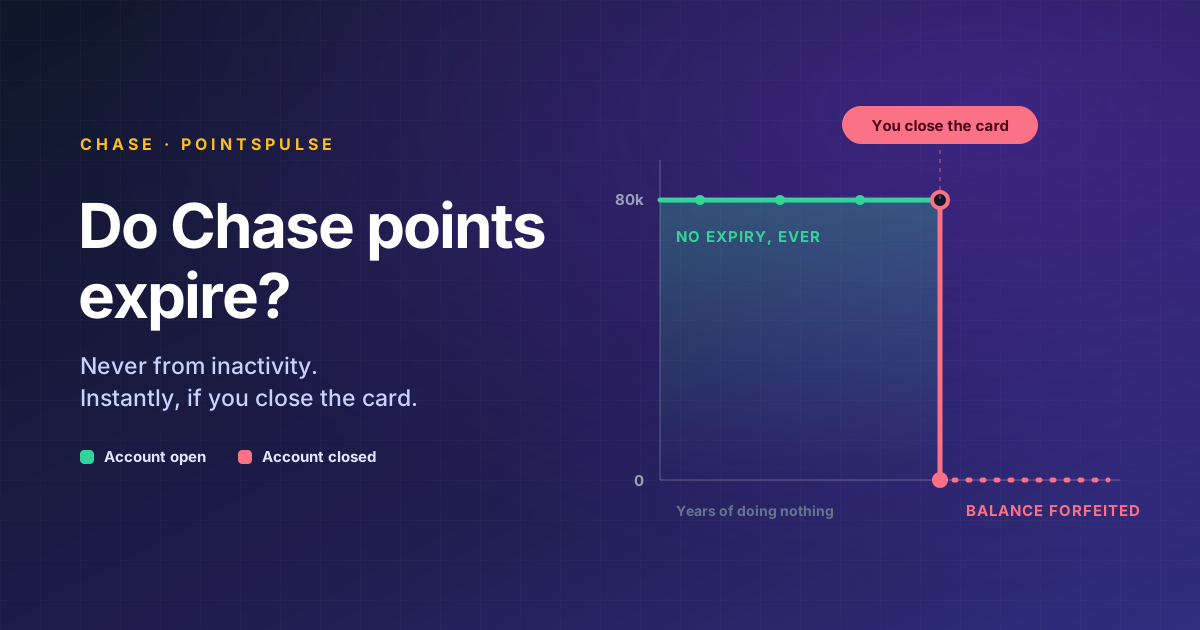
No. Chase Ultimate Rewards points do not expire from inactivity. You can leave a balance untouched for years and it will still be there, as long as the card account that earns those points stays open and in good standing. Unlike most airline miles, there is no 12 or 24 month clock ticking in the background.
So when people ask whether Chase Ultimate Rewards points expire, the answer is genuinely no, and it applies equally to Sapphire Preferred, Sapphire Reserve, Ink Business Preferred, and the Freedom cards. But it is also the answer that gets people into trouble, because it is only half the picture. Chase points do not expire. They get forfeited, and the difference matters enormously.
What actually kills Chase points
Inactivity is not on the list. These are:
- You close the card. By far the most common way people lose Chase points, and the one nobody plans for. More on this below, because it is the entire point of this post.
- Chase closes the card for missed payments. Fall 60 days past a minimum payment and your ability to use points is temporarily suspended. Keep going and the account can be closed with your entire balance permanently forfeited.
- Program misuse or fraud. If Chase determines you have abused the program, it can remove your points permanently, and that determination is generally not reversible.
- Bankruptcy. The card agreements allow Chase to take the points.
- Returns. Return a purchase and the points you earned on it, including bonus points, come back out of your balance. If you already spent them, your balance goes negative and future earnings pay off the deficit first.
The account closure trap
Here is the scenario, and it happens constantly.
Someone opens a Sapphire Preferred, earns the welcome bonus, sits on 80,000 points while they think about how to use them, and then the annual fee posts a year later. They do not have a trip planned. The fee annoys them. They call and close the card.
The points go with it.
Nothing warned them. Nothing about the balance sitting quietly in the account suggested it was tied to the card being open. And 80,000 Ultimate Rewards points is worth somewhere between $800 and $1,600 depending on how you use them, so this is not a rounding error. It is one of the most expensive routine mistakes in the entire hobby, and it is made by careful people who simply did not know.
The 30 day grace period that may not exist
You will read, in a lot of places, that you have 30 days after closing a Chase card to use your points. Be very careful with that.
Chase's own page does not say that. What it says is that if you close your card account before redeeming or transferring your rewards, you will no longer have those points. Full stop. No window, no grace.
Where the 30 days appears to come from is a different situation entirely: the program agreement provides a 30 day window when Chase closes an account for inactivity, and when Chase terminates the program. That is not the same as you voluntarily cancelling a card, and it is not the same as an account closed for missed payments, where forfeiture is immediate.
So the honest position is this. There may be a grace period after a voluntary closure. There may not be. Reports differ, Chase's own consumer page promises nothing, and the downside of being wrong is that you lose the entire balance.
Do not close a Chase card with points still in it and plan to sort them out afterwards. Move them first. It costs you five minutes and removes the question completely.
How to close a card and keep the points
All of these require you to act before the account closes. In order of how much value they preserve:
1. Move the points to another Chase card you already hold
If you have a second card that earns Ultimate Rewards, move the balance across and then close the first card. Nothing is lost. If you hold both an Ink Business Preferred and a Sapphire Preferred and want to stop paying two annual fees, this is the move.
2. Downgrade instead of closing
The most underused option. Rather than closing a Sapphire Preferred to escape the annual fee, downgrade it to a no annual fee card that still earns Ultimate Rewards, such as Freedom Unlimited or Freedom Flex. The account stays open, the points stay alive, and the fee goes away.
One catch worth knowing: points sitting on a Freedom card alone cannot be transferred to airline and hotel partners. Transfers require a premium card, meaning Sapphire Preferred, Sapphire Reserve, or Ink Business Preferred. Your points survive the downgrade, but they lose access to their most valuable use until you hold a premium card again. For most people who were about to cancel anyway, that is a fine trade. For someone sitting on a large balance earmarked for a business class redemption, it is not.
3. Move them to a household member
You can transfer points to another person in your household who holds an Ultimate Rewards earning card. Useful when you are exiting Chase entirely but your partner is not.
4. Transfer to an airline or hotel partner
This preserves the points, but it swaps one risk for another, and people rarely think it through. See below.
5. Cash them out
The last resort. Redeem for cash back or statement credit at one cent per point. You will usually get less value than a good travel redemption, but it is infinitely better than forfeiting the balance.
The transfer trap: how safe points become expiring points
This is the part that catches people who thought they were being careful.
While your points sit in Chase, they do not expire. That is a quiet but real form of insurance. The moment you transfer them to an airline or hotel partner, that insurance is gone and you inherit the partner's rules, and some of the most tempting partners have the harshest ones.
So someone closing a Sapphire Preferred in a hurry, who moves 100,000 points to a partner to "save" them, may have moved a balance that could never expire into a program where it very much can. If the trip then slips, the points can disappear entirely. They were safe where they started.
There is also a timing issue worth knowing about if you are reading this in 2026. Chase points have historically transferred to partners at 1:1, but World of Hyatt is now an exception. Sapphire Preferred cardholders who applied on or after 15 June 2026 already transfer to Hyatt at 4:3, and existing Sapphire Preferred holders keep the 1:1 rate only through 30 September 2026 before moving to 4:3 on 1 October. Ink Business Preferred holders keep 1:1 through 30 September 2026, then move to 4:3 as well. Chase Sapphire Reserve keeps the 1:1 rate.
In practice that means a 35,000 point Hyatt night that costs 35,000 Chase points today will cost roughly 47,000 once the 4:3 rate applies to your card. If you were already planning a Hyatt transfer and you hold a Sapphire Preferred or Ink Business Preferred, the maths changes at the start of October. That is a reason to book a confirmed award sooner, not a reason to move a balance you have no plans for.
It also matters for the downgrade path above. If you downgrade a Sapphire Preferred to a Freedom card and later want partner transfers again, which premium card you come back on determines your Hyatt rate.
Transfer when you have a specific award confirmed and ready to book, not as a rescue operation. We wrote the full framework on when you should and shouldn't transfer points, and a program by program breakdown of expiration rules for every major program.
Do Chase Ultimate Rewards points expire?
No. Do Chase Ultimate Rewards points ever expire on their own? Also no. Do Ultimate Rewards points expire if you simply never touch the card for three years? Still no. There is no inactivity clock of any kind.
The only question that matters is whether the account earning them stays open and in good standing, and the rest of this post is about the ways that goes wrong.
Do Chase Sapphire points expire?
No, with the same caveat. Sapphire Preferred and Sapphire Reserve both earn Ultimate Rewards, and Ultimate Rewards points do not expire from inactivity. Close the card without moving the points, though, and you lose them. Sapphire cards carry annual fees, which is precisely why people close them, which is precisely why Sapphire holders are the most exposed to this.
If the annual fee is your reason, downgrade rather than close.
Do Chase Freedom points expire?
No. Freedom, Freedom Unlimited, and Freedom Flex all earn Ultimate Rewards, and those points do not expire while the account is open and in good standing. Because these cards have no annual fee, there is far less pressure to close them, which makes them a natural home for a balance you want to keep alive.
This is the whole reason the downgrade path works. A no fee Freedom card is a permanent, free parking space for Ultimate Rewards points.
The short version
- Chase points never expire from inactivity. Not after 12 months, not after 24, not ever. That puts them in a very different category from airline miles, most of which run on a clock you have to actively reset.
- They are forfeited when the account closes, and possibly with no grace period at all.
- The fix is trivial and takes minutes: move the points, or downgrade instead of closing.
- Do not panic transfer to an airline partner to save them. You may be moving a balance that cannot expire into one that can.
The pattern underneath all of this is worth naming, because it applies well beyond Chase. The dangerous moment for your points is almost never the passage of time. It is a decision you make: closing a card, chasing a bonus, transferring in a hurry. Those decisions are much easier to get right when you can actually see what you are holding, which is the whole argument for using a points and miles tracker of some kind, ours or anyone else's.
Know exactly what you hold before you close a card
PointsPulse tracks your Chase, Amex, Citi, airline, and hotel balances in one dashboard, and warns you before anything is at risk. It reads your balances from the sites you already log into, and never stores your passwords. Free for up to 3 programs.
Try PointsPulse free