Do You Actually Need a Points Tracker?
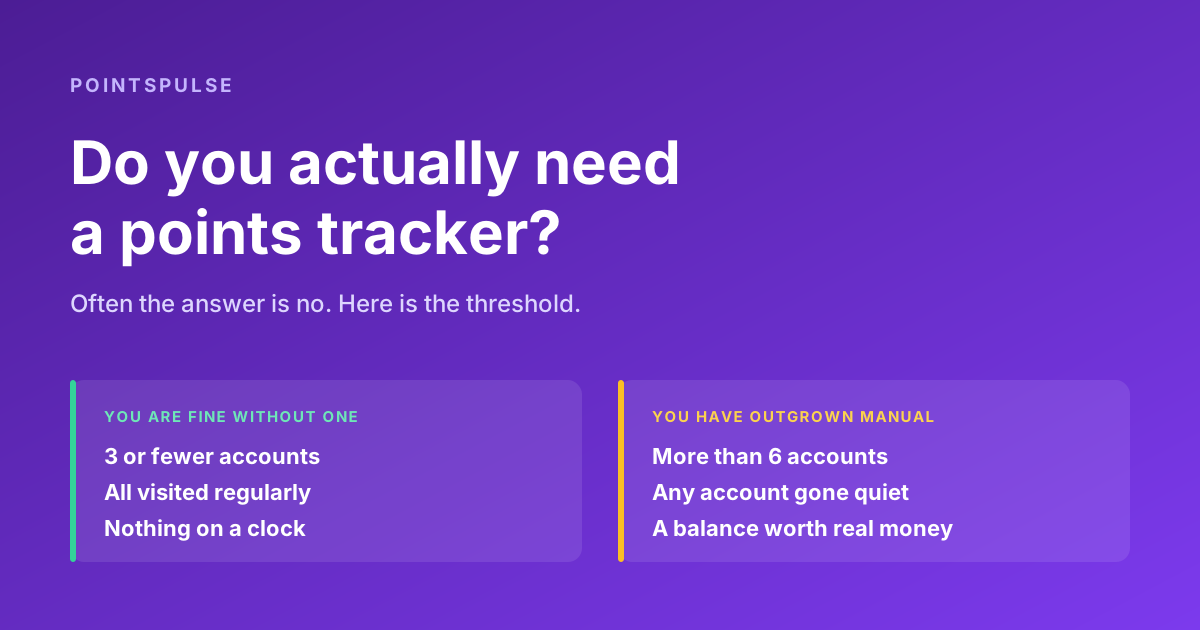
If you hold three or fewer loyalty accounts, log into each one at least once a quarter, and could tell us every balance right now within about ten percent, the answer is no. You do not need a tracking tool. You need to keep doing what you are already doing.
We build one of these tools, so that is an awkward sentence to open with. But it is true, and the alternative is worse. A tracker solves a problem of scale and forgetting. Below a certain number of accounts that problem simply does not exist yet, and any tool you install will sit there being redundant until it does.
What follows is the honest threshold: where tracking starts to earn its place, what it genuinely solves, and the three things it does not solve that people expect it to. If you already know you want one and just need to pick an approach, skip this and read how the different types of tracker actually work instead.
Three questions that decide it
Not features, not price. These three.
1. How many programs do you actually hold?
Not how many you use. How many you hold a balance in, however small. Count the airline you flew twice in 2019, the hotel chain from a conference, the supermarket scheme, the card you downgraded.
Do this on paper rather than in your head, because the accounts that come to mind are by definition the ones you have not forgotten. It is the others that matter. If your instinctive answer is four and writing it out gets you to seven, those extra three are the ones nobody is watching. If you have never actually counted, the points audit walkthrough takes about an hour and will give you a real number rather than a guess.
2. When did you last log into each one?
Go through your list and put a rough date next to each. Anything you have not opened in twelve months belongs in a separate column, because that is the category where value quietly disappears.
This matters more than the count. Six accounts you log into monthly is a manageable situation. Three accounts you have not touched since 2024 is not, even though it is half the number.
3. What is your largest single balance worth?
Take your biggest balance and multiply it by a cent. Then multiply it by two cents. Most major currencies land somewhere in that band, and The Points Guy publishes monthly valuations if you want a per program figure rather than a rough one.
A 90,000 point balance is somewhere between $900 and $1,800. Once you have said that number out loud, the question changes shape. Nobody keeps $1,400 in an account they never check and calls it fine, but people do exactly that with points, because points do not feel like money until the moment you lose them.
The threshold, stated plainly
There is no magic number, but there is a pattern, and it is about the shape of your portfolio rather than its size.
You are probably fine without a tool if: three or fewer active accounts, all visited regularly, no balance you would be upset to lose, and no accounts in programs that expire.
You are at the boundary if: four to six accounts, one or two of which you rarely open, and at least one balance in the tens of thousands. This is where a spreadsheet still works but starts requiring actual discipline.
You have outgrown manual tracking if: more than six accounts, or any account you have not opened in a year, or a balance worth more than a few hundred dollars sitting somewhere you do not routinely look. The count is not really the trigger. The forgotten account is.
The reason the forgotten account matters so much is that it fails silently. An account you check monthly gives you constant feedback. An account you have not opened since 2024 gives you nothing at all until the day you open it and find a number you did not expect, in either direction.
What a tracker genuinely solves
Three things, and it is worth being specific because tools are usually sold on vaguer promises than these.
The account you forgot you had
This is the biggest one and the least discussed. A full audit will often surface a balance you had stopped thinking about entirely. Sometimes it is 4,000 points and irrelevant. Sometimes it is 60,000 miles from a work trip four years ago, which is the version worth an hour of your time.
A tracker does not find these for you, to be clear. You still have to connect the account once. What it does is stop the account from disappearing again afterwards.
The clock you cannot see
Expiration risk is not where most people think it is. Delta, United, Southwest, JetBlue, and Alaska have all stopped expiring miles, so the airline anxiety that defined the last decade is mostly obsolete for US domestic programs. The risk has moved to hotels, to American, and to international carriers. We have the current rules program by program, and the pattern is that Marriott, Hilton, Hyatt, and IHG are where people actually get burned.
The problem with an expiration clock is that it is invisible from outside the account. Nothing tells you it is running. This is where automated tracking has a genuine structural advantage over any manual system, and it is also why, if you find a clock running, there are usually cheap ways to reset it without spending real money.
The question you cannot currently answer
Here is a test. Without looking anything up, what is the total dollar value of every loyalty balance you hold?
Almost nobody can answer that. It matters because you cannot make a sensible decision about a currency whose quantity you do not know. Should you transfer to book that flight, or pay cash? Should you open another card, or use what you have? Those questions have no good answer in the absence of a number, and most people resolve them by guessing.
What a tracker does not solve
This is the part vendors skip, so here it is.
It does not stop devaluation
A tracker shows you 100,000 points. What it cannot show you is that those points may buy noticeably less than they did a year ago, and it certainly cannot stop the program from making that change. Devaluation is the single largest destroyer of points value and no dashboard prevents it. The Consumer Financial Protection Bureau's 2024 report on rewards programs found devaluation to be one of the most common consumer complaints, alongside the finding that every quarter around four percent of accountholders lose access to at least some of their rewards. We keep a running record of the 2026 devaluations, and the honest position is that tracking your balance helps you react faster, not avoid the hit.
It does not make decisions
Knowing you hold 140,000 Amex points does not tell you whether to move them to a partner. That is a judgement about your travel plans, your risk tolerance, and whether a specific award is available, and it is irreversible once made. We have written about when transferring makes sense and when it does not, and the answer is more often "not yet" than people expect. No tool decides this for you, and any tool that claims to is selling something.
It does not see what it does not support
Every tracking tool covers a list of programs, and every list has holes. We cover seventeen. That is most of what most people hold, and it is not everything. If a meaningful share of your value sits in programs no tool reaches, a tool will give you a partial picture, which is sometimes worse than an honest manual one because it looks complete.
The case for using nothing at all
Worth stating properly rather than as a token gesture.
Every tool is a dependency. It is an account you create, a company that could change its pricing or be acquired or shut down, and a set of permissions or credentials you hand over. If you have two airline accounts and a hotel account, all of which you use, all of that is overhead in exchange for solving a problem you do not have.
There is also a version of this hobby that is genuinely better without tooling. If you hold one flexible currency, earn deliberately, and redeem within a few months of earning, a dashboard adds nothing. The complexity a tracker manages is complexity you have chosen not to create.
And if you want the middle path, a spreadsheet updated quarterly beats an unused tool comfortably. It covers every program without exception. Its weakness is attention rather than accuracy, and we say that from experience, having run one for eight years before abandoning it.
A five minute self test
Do this properly rather than reading it. Get a piece of paper.
- List every program you have ever earned in. Not the ones you use. Every one. Aim for at least eight lines before you stop.
- Write your best guess at each balance next to it, from memory.
- Log in and check three of them, ideally the three you are least sure about.
- Compare. How far off were you?
The result tells you what you need to know. If your guesses were close, your current system works and you should keep it. If one of them was wildly off, or an account had more in it than you remembered, or you could not remember the login at all, that gap is what a tracker is for. It will not get bigger on its own, but it will not get smaller either.
If the answer is yes
Then the next question is which kind, and the options differ less on features than on what they ask you to hand over. A spreadsheet costs you attention. A connected service costs you your loyalty program passwords. A browser extension costs you page access and completeness. That trade off is the whole decision, and we have laid it out in extension versus app versus spreadsheet.
If you would rather compare specific tools than approaches, our rundown of the main trackers covers the current options, including the ones that are better than ours at things we are not good at.
The short version
- Three or fewer accounts, all regularly visited, no expiring programs: you do not need a tool.
- The trigger is not how many accounts you have. It is whether any of them has gone quiet.
- Count your programs properly. Most people undercount by half, and the uncounted ones are the risk.
- A tracker solves forgetting, invisible expiration clocks, and the total you cannot currently state.
- It does not solve devaluation, redemption decisions, or programs it does not cover.
- A quarterly spreadsheet beats an unused tool. An unused tool is worse than nothing, because it feels like coverage.
The failure this is all guarding against is narrow and specific. It is not overpaying for a flight or missing a transfer bonus. It is opening an account eighteen months from now and finding a number that used to be bigger, or is now zero, and having had no idea it was happening.
If you have outgrown the spreadsheet
PointsPulse tracks seventeen airline, hotel, and credit card programs in one dashboard, and warns you before anything expires. It reads your balances from the sites you already log into, and never stores your passwords. Free for up to 3 programs.
Try PointsPulse free